
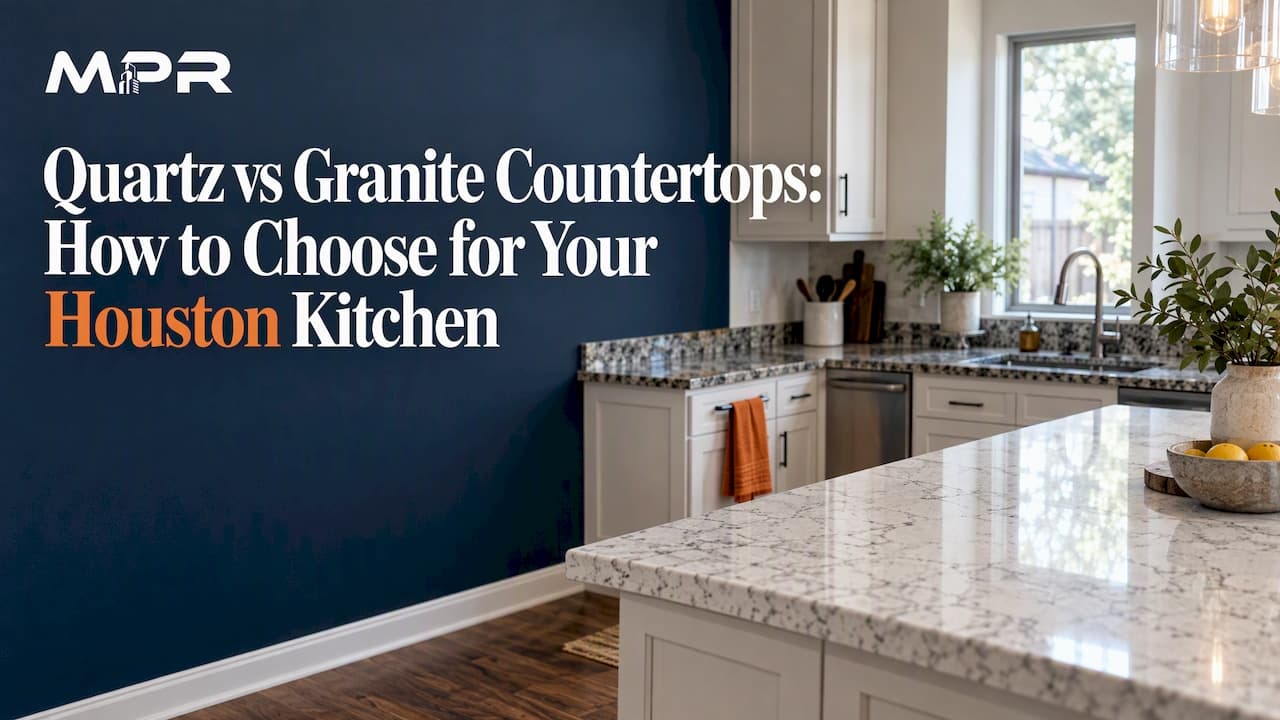
Quartz is the better pick if you want a uniform look and the least upkeep. Granite is the better pick if you want a one-of-a-kind natural slab and you cook hot. Both are excellent kitchen surfaces. The right one depends on how you cook, how much maintenance you will tolerate, and what look you want in your kitchen renovation.
This guide compares the two across durability, appearance, maintenance, stains, heat, cost and long-term value. It also covers quartzite, the third stone that keeps coming up in showroom conversations. If you are planning kitchen remodeling in Houston, it should help you walk into a showroom with a clear idea of what you want.
TL;DR
- Quartz is engineered stone: ground stone bound with resin. It gives consistent patterns, needs no sealing and is very easy to live with.
- Granite is natural stone. Every slab is different, and it handles direct heat from pots and pans better than quartz.
- Durability is close to a tie. Consumer Reports found both perform very well in its tests. Chips happen on sharp edges in either material, so choose a rounded or eased edge.
- Cost overlaps heavily. Each material spans budget to premium tiers, so the slab you pick matters more than the material name.
- Resale: a neutral, well-fabricated countertop helps most. Pick the one that suits your household, not a trend.
Table of Contents
- What you are actually comparing
- Durability: a close race
- Appearance: consistency or character
- Maintenance and stain resistance
- Heat resistance: granite wins
- Side-by-side comparison
- What about quartzite?
- Cost: what to expect without chasing a number
- Long-term value and resale
- Which one fits you?
- Our perspective
- Planning your kitchen project with us
- Questions homeowners ask
- Sources
What you are actually comparing
The two materials start from different places.
Quartz countertops are manufactured. According to 2025 consumer data from SoFi, quartz is an engineered product made of stone particles and resin. It needs no sealing and comes in a wide range of consistent patterns.
Granite is quarried from the earth and cut into slabs. Its patterns are unique, and some varieties may need periodic sealing to keep stain resistance at its best, per the same source.
That difference explains almost everything else on this page: why quartz looks uniform, why granite varies from slab to slab, and why one tolerates a hot pan better than the other.

Durability: a close race
Both materials are tough. Consumer Reports tested both against sharpened steak knives on a slicing rig and found they perform very well, with both resisting cuts and abrasion.
Hardness testing tells a similar story. In a performance comparison published by Use Natural Stone, the two granites tested had Mohs hardness values between 6 and 7. You will not scratch either surface with kitchen knives in normal use. Still, cutting directly on any stone dulls your knives, so use a cutting board.
Chips are the real weak point
The common failure is not scratching, it is chipping. Good Housekeeping notes that square edges on quartz are prone to chipping, and its guidance applies to both stones: rounded or eased edges resist chips far better than square edges. Repairs are also a specialist job, because the fixer has to match the color and pattern.
If you have kids, a heavy cast-iron habit or a busy household, put the edge profile on your decision list next to the material itself. Good fabrication matters as much as the slab.
Appearance: consistency or character
This is where most people decide.
Quartz gives you control. Because it is manufactured, a slab looks like the sample, and the next slab will match. Lighter, whiter and more uniform options are easy to find, and so are patterns that imitate marble. If you want a calm, modern kitchen, or a crisp white one, quartz delivers it predictably. Good Housekeeping lists a wide range of colors and patterns among quartz's strengths.
Granite gives you character. Veining, flecks and movement vary across a slab, and no two are identical. If you love an organic look, choose granite and pick your actual slab in person rather than from a small sample. A sample tile can look nothing like a full slab.

One practical tip: whichever you choose, pick the slab with your cabinets, wall color and flooring in view. Countertops are the most expensive finish in the room to get wrong, and paint is the easiest to adjust. We usually suggest locking in the stone first and then choosing wall and cabinet colors around it.
Maintenance and stain resistance
Quartz
Quartz is non-porous, so liquids do not soak in. Consumer Reports found quartz generally does better against certain stainers, such as beet juice and food coloring, though both materials handle everyday kitchen use well when cared for. Daily care is a wipe with mild soap and water.
Granite and the sealing question
Granite's reputation for high maintenance is partly out of date. The Natural Stone Institute states that most granite countertops do not need to be sealed. It also explains that sealers repel liquids rather than make stone impervious, and many modern slabs receive a factory resin treatment that fills tiny fissures.
So the honest answer is: it depends on the stone. Lighter, coarser or more porous granites are more likely to benefit from a sealer. Ask your fabricator which one your slab is, and whether they recommend sealing and how often. A simple test many pros suggest is to put a few drops of water on the surface and see whether it darkens and soaks in. Ask your installer to show you how for your specific slab.
For cleaning, stick with gentle products. The Natural Stone Institute's care guidance recommends mild, non-acidic cleaners for stone that is sensitive to acids, so skip vinegar and harsh bathroom cleaners on stone surfaces.
Heat resistance: granite wins
Neither material is a trivet, but they differ. Quartz is held together with resin, and the Use Natural Stone testing discussion notes that manufacturers of engineered quartz often advise against placing hot pans directly on the surface, because the resin can scorch or discolor. Granite is generally considered safe for direct heat such as a pan off the stove.
In practice, use trivets with both. But if you regularly pull a pan off a burner and set it down, granite forgives that habit far more than quartz does.
Side-by-side comparison
| Factor | Quartz | Granite |
|---|---|---|
| Material | Engineered: stone particles and resin | Natural quarried stone |
| Pattern | Consistent, predictable | Unique to each slab |
| Sealing | Not required | Depends on the stone; many slabs need little or none |
| Stain resistance | Non-porous, very good | Very good, better when properly treated |
| Heat | Use trivets; resin can scorch | Generally handles direct heat |
| Chips | Possible on sharp edges | Possible on sharp edges |
| Best for | Modern look, low upkeep | Natural character, hot cooking |
What about quartzite?
Many Houston homeowners confuse quartz and quartzite, and showrooms do not always help. They are different things. Quartzite is a natural stone, formed when sandstone is transformed by heat and pressure. Quartz is the engineered product described above.
Quartzite is often chosen for a marble-like look with the toughness of natural stone, and it generally sits at the premium end of the price range. It is, like granite, a natural material, so slabs vary and you should inspect the one you are buying. Because quartzite and granite behave differently from one slab to the next, ask your fabricator how the specific stone you are considering is treated and whether it needs sealing. If you are comparing granite and quartzite directly, think of it as two natural stones: granite is usually the more budget-friendly and varied, quartzite the more dramatic and often pricier.
Cost: what to expect without chasing a number
We are not going to quote a price per square foot, because it would be out of date by the time you read it and every kitchen is different. Here is how to think about it instead.
- The ranges overlap. Published national figures for both materials span wide ranges. SoFi's 2025 cost guide shows granite and quartz installed prices that overlap heavily, reflecting different quality grades and local installation fees. Neither is simply the cheaper one.
- The slab grade drives price. Rare or exotic granite costs far more than a common one. Quartz pricing depends heavily on the manufacturer and collection.
- Fabrication is a big part of the bill. Edge profiles, cutouts for sinks and cooktops, seams, backsplashes and the removal of old tops all add up.
- Layout matters. A kitchen with an island, long runs or a waterfall edge uses far more material than a small galley kitchen.
When you gather kitchen remodel costs, ask each bidder to price the same slab, the same edge and the same scope. That is the only way to compare estimates fairly. A quote that looks cheap often leaves out demolition, plumbing reconnection, or the backsplash.
Long-term value and resale
A countertop upgrade is one of the more popular pieces of a minor kitchen refresh. A 2025 industry article from a stone fabricator reports that cosmetic kitchen refreshes can recoup a significant portion of their cost, and that neutral, high-quality finishes tend to do best at resale. Treat that as a general industry view rather than a promise for any specific house.
The practical takeaway: if you may sell within a few years, choose a neutral, well-made countertop in a classic color. If this is your long-term home, choose the one you will still enjoy, and the one whose upkeep you will actually keep up with. A beautiful surface you are afraid to use is not good value.
Which one fits you?
Choose quartz if:
- You want a uniform, clean look, especially a white or light kitchen.
- You do not want to think about sealing.
- You want matching slabs across a large island and perimeter.
- You use trivets as a habit.
Choose granite if:
- You love natural variation and want a slab nobody else has.
- You cook a lot and set hot cookware down near the stove.
- You like the idea of a natural material and will check on sealing if your slab needs it.
- You want a wide selection of colors across a broad price spectrum.
Consider quartzite if you want the look of natural marble with a harder, more durable feel, and the budget is flexible.
No material is wrong here. Whichever you pick, the edge profile and the quality of the fabricator will affect how it holds up as much as the stone does.
Our perspective
We paint and remodel homes in Houston, and kitchens are where homeowners most often get stuck on one big decision and lose sight of the rest. Our view is simple. Treat the countertop as one part of a whole room. The stone you choose will set the tone for your cabinet color, wall paint, backsplash and flooring, so decide it early and let the other finishes follow.
We also tell homeowners to be wary of anyone who says one material is flatly better. Quartz and granite are both good. The mistakes we see are rushing the slab choice, comparing estimates that cover different scopes, and skipping a close look at the edge and seam details. A free, in-person consultation is the place to sort those out, with the actual kitchen in front of you.
If you are also refreshing walls, trim or cabinets, plan the sequence so the painting happens after the heavy work and the countertop install, to protect the new finishes. That order saves touch-ups.
— Abraham
Planning your kitchen project with us
If you are weighing a countertop change as part of a bigger update, our kitchen remodeling team handles the project from the free consultation through the final walkthrough. We are licensed and insured, and we offer flexible financing options for homeowners who want to move forward without paying for everything at once.
The finishing touches matter too. Fresh interior painting after a new countertop goes in pulls the room together, and our full home remodeling page shows the other work we do, from flooring to custom carpentry. When you are ready, request a free estimate and tell us what you are planning. We will walk through your kitchen with you, scope the work clearly and put it in writing.
Questions homeowners ask
Is quartz or granite better for a kitchen?
Neither wins outright. Quartz suits you if you want consistent patterns and no sealing, while granite suits you if you want a natural, one-of-a-kind slab and better tolerance for hot pans. Consumer Reports found both perform very well in durability testing.
Does granite really need to be sealed?
Not always. The Natural Stone Institute says most granite countertops do not need sealing, and many slabs get a factory resin treatment. Ask your fabricator about your specific slab and how to test it.
Which is more expensive, quartz or granite?
It depends on the slab, the manufacturer and the fabrication. Published ranges for the two overlap, and each runs from budget to premium. Compare estimates for the same material, edge and scope to see the real difference.
Can you put hot pans on quartz?
It is best not to. Quartz manufacturers often advise against it because the resin can scorch or discolor. Use a trivet with any countertop, and especially with quartz.
Is quartzite the same as quartz?
No. Quartzite is a natural stone, while quartz is engineered from stone particles and resin. They look and behave differently, so confirm which one is on your quote.
Sources
- Quartz vs. Granite Better Countertop Material, Consumer Reports
- Cost of Countertops & Installation, SoFi
- Sealing Natural Stone Countertops, Natural Stone Institute
- Learn About Cleaning Products for Natural Stone, Natural Stone Institute
- Testing the Performance of Granite, Engineered Quartz, Concrete, and Sintered Countertop Surfaces, Use Natural Stone
- 6 Best Countertop Materials for Kitchens, Good Housekeeping
- Do New Countertops Really Add Value to Your Home in 2025?, Granite and Marble Solutions